About
A friendship built in a Malawian field.
A platform built on twenty years of trust.
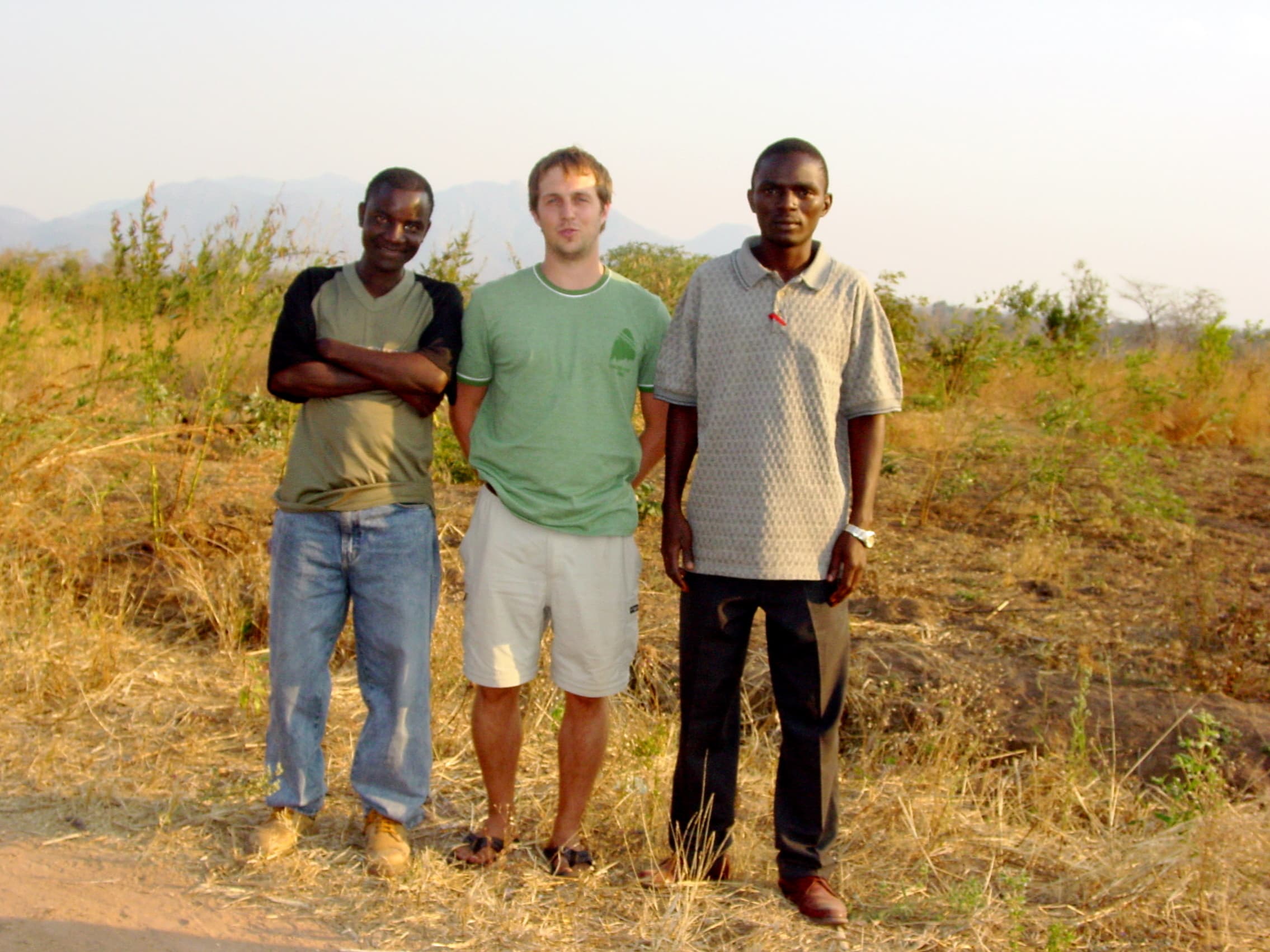
Malawi fieldwork, 2004
In 2004, Dustin Chambers arrived in rural Malawi as a graduate researcher, partnered with Water for People to study accessible water and sanitation for disabled farming communities. Shabani Kamphambe was his field partner — a community health worker responsible for 30,000 people across his district, who understood the land, the people, and the gap between what development organizations promised and what farmers actually needed. They worked in the same villages, asked questions alongside each other, and left with a genuine friendship and each other's contact details.
Twenty years passed. Dustin returned to Denver, completed his MSc, and joined a leading design agency. Water for People later brought him on as lead designer for a global data reporting platform — work that won the Gold Stevie Award, Bronze International UX Award, and SXSW Interaction Award Finalist in 2013. Shabani left health work to do something he'd been thinking about for years: farm his own land.
He grows maize and groundnuts in rotation on one acre he knows intimately — drainage patterns, input costs, which fertilizer pays off at which stage. This cycle's maize harvest came in at 1,380 kg (23 bags), roughly 3.4 t/ha — about double the Malawi national average of ~1.7 t/ha in a drought-hit season. And he doesn't operate alone. Every phase of his season moves money through Chiotcha Village: laborers hired by the day to clear land, local suppliers selling seed and fertilizer, transport workers getting the harvest to market. Shabani isn't just growing food for his household — he's running a productive micro-enterprise that creates wages and commerce for the people around him.
This is precisely what microfinancing was designed to do: put capital where creditworthiness already exists but formal systems don't reach. Shabani isn't a charity case. He has land, knowledge, and a track record. What he needed was a way to fund each phase of work at the right moment — small amounts, without the overhead that makes traditional microloans uneconomical at his scale. Donors aren't giving to someone in need; they're backing someone already doing the work, removing the one friction standing between a capable farmer and a fully productive season.
FarmFund makes that direct. Each donation targets a named, specific need — a weeding crew, a bag of fertilizer, tractor hire for a new plot. When funded, Shabani purchases it, posts the receipt, and the farm map advances. Your contribution didn't disappear into an opaque pool; it paid someone's wages or stocked a local supplier within days of landing. That visibility is rare in development finance. We think it should be the standard.
The Bigger Picture
The model scales because the principle is sound: a creditworthy farmer, a funded phase of work, a receipt, a harvest. The same infrastructure supporting Shabani can run across hundreds of farms — giving NGOs, agricultural development organizations, and impact investors a transparent, farmer-managed accountability layer that shows exactly where capital went and what it produced. Not charity administered from afar. Productive investment, documented on the ground.
It starts with one farm, one friendship, and a bet that transparent microfinancing — where donors see the work and farmers keep the dignity — is better than the alternative.